

Reconceptualizing Mathematics 2nd Edition Pdf
Reconceptualizing Mathematics for Elementary School Teachers 3rd edition
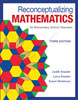
Judith Sowder, Larry Sowder, and Susan Nickerson
Publisher: Macmillan Learning
Your students can pay an additional fee for access to an online version of the textbook that might contain additional interactive features. Your students are allowed unlimited access to WebAssign courses that use this edition of the textbook at no additional cost. Save time with ready-to-use assignments built by subject matter experts specifically for this textbook. You can customize and schedule any of the assignments you want to use. Additional instructional and learning resources are available with the textbook, and might include testbanks, slide presentations, online simulations, videos, and documents.
eBook

Lifetime of Edition (LOE)

Course Packs

Textbook Resources
- Try an Example Assignment
- Course Packs
- Terms of Use
- Terms of Use
Access is contingent on use of this textbook in the instructor's classroom.
- Table of Contents
- Table of Contents
- Chapter 1: Reasoning About Quantities
- 1.1: Ways of Thinking About Solving Story Problems
- 1.2: Quantitative Analysis (8)
- 1.3: Problem Solving (5)
- 1.4: Issues for Learning: Ways of Illustrating Story Problems (6)
- 1.5: Check Yourself
- Chapter 2: Numeration Systems
- 2.1: Ways of Expressing Values of Quantities (4)
- 2.2: Place Value (5)
- 2.3: Bases Other Than Ten (8)
- 2.4: Operations in Different Bases (4)
- 2.5: Issues for Learning: Understanding Place Value
- 2.6: Check Yourself
- Chapter 3: Understanding Whole Number Operations
- 3.1: Ways of Thinking About Addition and Subtraction (3)
- 3.2: Children's Ways of Adding and Subtracting (3)
- 3.3: Ways of Thinking About Multiplication (11)
- 3.4: Ways of Thinking About Division (4)
- 3.5: Children Find Products and Quotients (1)
- 3.6: Issues for Learning: Developing Number Sense (2)
- 3.7: Check Yourself
- Chapter 4: Some Conventional Ways of Computing
- 4.1: Operating on Whole Numbers and Decimal Numbers (12)
- 4.2: Issues for Learning: The Role of Algorithms
- 4.3: Check Yourself
- Chapter 5: Using Numbers in Sensible Ways
- 5.1: Mental Computation (7)
- 5.2: Computational Estimation (8)
- 5.3: Estimating Values of Quantities (3)
- 5.4: Using Scientific Notation for Estimating Values of Very Large and Very Small Quantities (11)
- 5.5: Issues for Learning: Mental Computation
- 5.6: Check Yourself
- Chapter 6: Meanings for Fractions
- 6.1: Understanding the Meanings of a ⁄ b (15)
- 6.2: Comparing Fractions (9)
- 6.3: Equivalent (Equal) Fractions (9)
- 6.4: Relating Fractions, Decimals, and Percents (18)
- 6.5: Issues for Learning: Understanding Fractions and Decimals
- 6.6: Check Yourself
- Chapter 7: Computing with Fractions
- 7.1: Adding and Subtracting Fractions (11)
- 7.2: Multiplying by a Fraction (12)
- 7.3: Dividing by a Fraction (11)
- 7.4: Issues for Learning: Teaching Calculation with Fractions (8)
- 7.5: Check Yourself
- Chapter 8: Multiplicative Comparisons and Multiplicative Reasoning
- 8.1: Quantitative Analysis of Multiplicative Situations (4)
- 8.2: Fractions in Multiplicative Comparisons (16)
- 8.3: Issues for Learning: Standards for Learning
- 8.4: Check Yourself
- Chapter 9: Ratios, Rates, Proportions, and Percents
- 9.1: Ratio as a Measure (2)
- 9.2: Comparing Ratios (12)
- 9.3: Percents in Comparisons and Changes (16)
- 9.4: Issues for Learning: Developing Proportional Reasoning
- 9.5: Check Yourself
- Chapter 10: Integers and Other Number Systems
- 10.1: Big Ideas About Signed Numbers (6)
- 10.2: Children's Ways of Reasoning About Signed Numbers (2)
- 10.3: Other Models for Signed Numbers (2)
- 10.4: Operations with Signed Numbers (6)
- 10.5: Multiplying and Dividing Signed Numbers (4)
- 10.6: Number Systems (3)
- 10.7: Issues for Learning: Open Number Sentences
- 10.8: Check Yourself
- Chapter 11: Number Theory
- 11.1: Factors and Multiples, Primes and Composites (5)
- 11.2: Prime Factorization (6)
- 11.3: Divisibility Tests to Determine Whether a Number is Prime (8)
- 11.4: Greatest Common Factor, Least Common Multiple (7)
- 11.5: Issues for Learning: Understanding the Unique Factorization Theorem (1)
- 11.6: Check Yourself
- Chapter 12: What Is Algebra?
- 12.1: Algebraic Reasoning in Elementary School (5)
- 12.2: Numerical Patterns and Algebra (4)
- 12.3: Functions and Algebra (8)
- 12.4: Algebra as Generalized Arithmetic (4)
- 12.5: Algebraic Reasoning About Quantities (5)
- 12.6: Issues for Learning: The National Assessment of Educational Progress and Achievement in Algebra
- 12.7: Check Yourself
- Chapter 13: A Quantitative Approach to Algebra and Graphing
- 13.1: Using Graphs and Algebra to Show Quantitative Relationships (4)
- 13.2: Understanding Slope: Making Connections Across Quantitative Situations, Graphs, and Algebraic Equations (7)
- 13.3: Linear Functions and Proportional Relationships (5)
- 13.4: Nonlinear Functions (4)
- 13.5: Issues for Learning: Algebra in the Elementary Grades
- 13.6: Check Yourself
- Chapter 14: Understanding Change: Relationships Among Time, Distance, and Rate
- 14.1: Distance–Time and Position–Time Graphs (2)
- 14.2: Using Motion Detectors (1)
- 14.3: Graphs of Speed Against Time (2)
- 14.4: Interpreting Graphs (3)
- 14.5: Issues for Learning: Common Graphing Errors
- 14.6: Check Yourself
- Chapter 15: Further Topics in Algebra and Change
- 15.1: Finding Linear Equations (4)
- 15.2: Solving Two Linear Equations in Two Variables (3)
- 15.3: Different Approaches to Problems (2)
- 15.4: Average Speed and Weighted Averages (1)
- 15.5: More About Functions (3)
- 15.6: Issues for Learning: Topics in Algebra (1)
- 15.7: Check Yourself
- Chapter 16: Polygons
- 16.1: Review of Polygon Vocabulary (3)
- 16.2: Organizing Shapes (2)
- 16.3: Triangles and Quadrilaterals (2)
- 16.4: A Focus on Problem-Solving Strategies (2)
- 16.5: Issues for Learning: Some Research on Two-Dimensional Shapes (1)
- 16.6: Check Yourself
- Chapter 17: Polyhedra
- 17.1: Shoeboxes Have Faces and Nets! (1)
- 17.2: Introduction to Polyhedra (3)
- 17.3: Representing and Visualizing Polyhedra (3)
- 17.4: Congruent Polyhedra (1)
- 17.5: Some Special Polyhedra (3)
- 17.6: Issues for Learning: Dealing with 3D Shapes
- 17.7: Check Yourself
- Chapter 18: Symmetry
- 18.1: Symmetry of Shapes in a Plane (3)
- 18.2: Symmetry of Polyhedra (3)
- 18.3: Issues for Learning: What Is Geometry in the Pre-K–8 Curriculum?
- 18.4: Check Yourself
- Chapter 19: Tessellations
- 19.1: Tessellating the Plane (2)
- 19.2: Tessellating Space (3)
- 19.3: Check Yourself
- Chapter 20: Similarity
- 20.1: Similarity and Dilations in Planar Figures (4)
- 20.2: More About Similar Figures (2)
- 20.3: Similarity in 3D Figures (4)
- 20.4: Issues for Learning: Similarity and Proportional Reasoning (1)
- 20.5: Check Yourself
- Chapter 21: Curves, Constructions, and Curved Surfaces
- 21.1: Planar Curves and Constructions (6)
- 21.2: Curves Surfaces (5)
- 21.3: Issues for Learning: Standards for Mathematical Practice
- 21.4: Check Yourself
- Chapter 22: Transformation Geometry
- 22.1: Some Types of Rigid Motions (2)
- 22.2: Finding Images for Rigid Motions (2)
- 22.3: A Closer Look at Some Rigid Motions (2)
- 22.4: Composition of Rigid Motions (2)
- 22.5: Transformations and Earlier Topics (2)
- 22.6: Issues for Learning: Promoting Visualization in the Curriculum (1)
- 22.7: Check Yourself
- Chapter 23: Measurement Basics
- 23.1: Key Ideas of Measurement (4)
- 23.2: Length and Angle Size (4)
- 23.3: Issues for Learning: Measurement of Length and Angle Size
- 23.4: Check Yourself
- Chapter 24: Area, Surface Area, and Volume
- 24.1: Area and Surface Area (4)
- 24.2: Volume (4)
- 24.3: Issues for Learning: Measurement of Area and Volume (1)
- 24.4: Check Yourself
- Chapter 25: Counting Units Fast: Measurement Formulas
- 25.1: Circumference, Area, and Surface Area Formulas (5)
- 25.2: Volume Formulas (5)
- 25.3: Issues for Learning: What Measurement Topics Are in the Curriculum?
- 25.4: Check Yourself
- Chapter 26: Special Topics in Measurement
- 26.1: The Pythagorean Theorem (4)
- 26.2: Some Other Kinds of Measurements (4)
- 26.3: Check Yourself
- Chapter 27: Quantifying Uncertainty
- 27.1: Understanding Chance Events (5)
- 27.2: Methods of Assigning Probabilities (12)
- 27.3: Simulating Probabilistic Situations (3)
- 27.4: Issues for Learning: Research on the Understanding of Probability
- 27.5: Check Yourself
- Chapter 28: Determining More Complicated Probabilities
- 28.1: Tree Diagrams and Lists for Multistep Experiments (6)
- 28.2: Probability of One Event or Another Event (4)
- 28.3: Probability of One Event and Another Event (4)
- 28.4: Conditional Probability (4)
- 28.5: Probability and Problem Solving (1)
- 28.6: Check Yourself
- Chapter 29: Introduction to Statistics and Sampling
- 29.1: What Are Statistics? (3)
- 29.2: Sampling: The Why and the How (3)
- 29.3: Simulating Random Sampling (4)
- 29.4: Types of Data (2)
- 29.5: Conducting a Survey
- 29.6: Issues for Learning: Sampling
- 29.7: Check Yourself
- Chapter 30: Representing and Interpreting Data with One Variable
- 30.1: Representing Categorical Data (2)
- 30.2: Representing and Interpreting Measurement Data (1)
- 30.3: Examining the Spread of Data (4)
- 30.4: Measures of Center (2)
- 30.5: Deviations from the Mean as Measures of Spread (2)
- 30.6: Examining Distributions (3)
- 30.7: Issues for Learning: Understanding the Mean (2)
- 30.8: Check Yourself
- Chapter 31: Dealing with Multiple Data Sets or with Multiple Variables
- 31.1: Comparing Data Sets (5)
- 31.2: Lines of Best Fit and Correlation (3)
- 31.3: Issues for Learning: More Than One Variable
- 31.4: Check Yourself
- Chapter 32: Variability in Samples
- 32.1: Having Confidence in a Sample Statistic (6)
- 32.2: Confidence Intervals (4)
- 32.3: Issues for Learning: What Probability and Statistics Should Be in the Curriculum?
- 32.4: Check Yourself
- Chapter 33: Special Topics in Probability
- 33.1: Expected Value (8)
- 33.2: Permutations and Combinations (11)
- 33.3: Issues for Learning: Children Finding Permutations
- 33.4: Check Yourself
Available July 2017
Reconceptualizing Mathematics for Elementary School Teachers, 3rd Edition, by Judith Sowder, Larry Sowder, and Susan Nickerson is founded on many years' research and studies of learning processes and mathematics education. Reconceptualizing Mathematics is designed for use in classrooms in which students take an active part in learning mathematics. This team of esteemed authors has written the only textbook of its kind to both incorporate aspects of student-centered learning into lessons and model the teaching that will be expected of their students. To this end, the authors provide worthwhile tasks, activities, and support for facilitating discussions.
Quantitative reasoning and problem solving are recurring themes in Reconceptualizing Mathematics. The authors approach problem solving in a way that teaches students to understand the elements present in the situation and how they relate to each other.
Macmillan Learning and WebAssign have partnered to deliver a comprehensive and flexible suite of resources for your math for teachers course. Combining the most widely used online homework platform with authoritative textbook content, Reconceptualizing Mathematics extends and enhances the classroom experience for instructors and students.
Features:
- Links under each question quickly jump to the corresponding section of a complete eBook.
- Detailed, worked-out solutions for all questions are available to students at your discretion.
- Instructor resources include Lecture, Image, and iClicker PowerPoint Slides, Test Bank links, an Instructor's Guide, an Instructor Resource Manual, and an Instructor Solutions Manual.
- Student resources include Practice Quizzes, a Student Solutions Manual, Learning Curve links, Data Sets, MathClips Video links, Printable & Electronic Manipulatives, Suggested Websites, Tables, and Web Appendices.
Questions Available within WebAssign
Most questions from this textbook are available in WebAssign. The online questions are identical to the textbook questions except for minor wording changes necessary for Web use. Whenever possible, variables, numbers, or words have been randomized so that each student receives a unique version of the question. This list is updated nightly.
Question Availability Color Key
BLACK questions are available now
GRAY questions are under development
| Group | Quantity | Questions |
|---|---|---|
| Chapter 1: Reasoning About Quantities | ||
| 1.2 | 8 | 001 002 004 005 006 007 008 009 |
| 1.3 | 5 | 002 004 005 006 008 |
| 1.4 | 6 | 002 003 004 005 006 008 |
| Chapter 2: Numeration Systems | ||
| 2.1 | 4 | 004 005 006 009 |
| 2.2 | 5 | S.007 001 005 006 008 |
| 2.3 | 8 | 002 013 014 015 016 018 021 022 |
| 2.4 | 4 | S.005 003 004 005 |
| Chapter 3: Understanding Whole Number Operations | ||
| 3.1 | 3 | 003 006 009 |
| 3.2 | 3 | S.003 002 005 |
| 3.3 | 11 | S.006 S.008 S.012 007 008 010 012 014 018 020 022 |
| 3.4 | 4 | S.008 S.015 005 006 |
| 3.5 | 1 | S.003 |
| 3.6 | 2 | 004 005 |
| Chapter 4: Some Conventional Ways of Computing | ||
| 4.1 | 12 | S.001 S.008 S.011 001 002 005 007 008 010 011 012 013 |
| Chapter 5: Using Numbers in Sensible Ways | ||
| 5.1 | 7 | S.001 S.002 001 003 004 005 006 |
| 5.2 | 8 | S.001 S.002 001 003 004 006 007 008 |
| 5.3 | 3 | S.001 S.003 002 |
| 5.4 | 11 | S.002 S.003 S.004 S.005 S.006 S.008 001 003 004 008 010 |
| Chapter 6: Meanings for Fractions | ||
| 6.1 | 15 | S.002 S.005 S.008 S.009 001 003 006 011 012 013 016 018 021 023 025 |
| 6.2 | 9 | S.002 S.003 S.004 004 005 006 008 011 014 |
| 6.3 | 9 | S.005 S.007 001 003 005 006 008 011 012 |
| 6.4 | 18 | S.001 S.002 S.007 S.013 S.015 S.018 001 002 003 004 005 008 009 013 014 015 016 018 |
| Chapter 7: Computing with Fractions | ||
| 7.1 | 11 | S.008 003 005 006 008 010 011 012 013 016 018 |
| 7.2 | 12 | S.001 S.005 S.010 002 004 006 009 012 017 018 019 020 |
| 7.3 | 11 | S.004 S.006 S.007 002 004 005 010 011 012 013 014 |
| 7.4 | 8 | 001 002 003 004 005 006 007 008 |
| Chapter 8: Multiplicative Comparisons and Multiplicative Reasoning | ||
| 8.1 | 4 | 001 002 003 006 |
| 8.2 | 16 | S.001 S.003 S.004 S.006 S.009 001 002 003 004 005 006 007 009 010 012 013 |
| Chapter 9: Ratios, Rates, Proportions, and Percents | ||
| 9.1 | 2 | 003 007 |
| 9.2 | 12 | 001 002 004 005 006 007 008 009 010 013 020 024 |
| 9.3 | 16 | CS.003 CS.013 CS.020 004 007 008 009 011 013 015 016 017 026 027 030 031 |
| Chapter 10: Integers and Other Number Systems | ||
| 10.1 | 6 | S.001 S.002 001 003 004 007 |
| 10.2 | 2 | 001 002 |
| 10.3 | 2 | S.001 003 |
| 10.4 | 6 | 001 002 004 006 009 013 |
| 10.5 | 4 | S.002 002 003 006 |
| 10.6 | 3 | 002 010 012 |
| Chapter 11: Number Theory | ||
| 11.1 | 5 | 002 008 011 013 016 |
| 11.2 | 6 | 002 007 008 010 012 013 |
| 11.3 | 8 | S.004 001 004 006 011 014 018 021 |
| 11.4 | 7 | 005 006 008 013 021 023 027 |
| 11.5 | 1 | 002 |
| Chapter 12: What Is Algebra? | ||
| 12.1 | 5 | 001 004 005a 007 009 |
| 12.2 | 4 | 001 004 005 011 |
| 12.3 | 8 | 002 003 004 005 009 010 012 016 |
| 12.4 | 4 | 002 003 004 016 |
| 12.5 | 5 | 001 002 004 009 013 |
| Chapter 13: A Quantitative Approach to Algebra and Graphing | ||
| 13.1 | 4 | 003 005 006 008 |
| 13.2 | 7 | 001 003 004 006 007 008 011 |
| 13.3 | 5 | 001 003 006 008 009 |
| 13.4 | 4 | 001 002 003 004 |
| Chapter 14: Understanding Change: Relationships Among Time, Distance, and Rate | ||
| 14.1 | 2 | 007 010 |
| 14.2 | 1 | 001 |
| 14.3 | 2 | 005 010 |
| 14.4 | 3 | 001 006 007 |
| Chapter 15: Further Topics in Algebra and Change | ||
| 15.1 | 4 | S.013 004 012 020 |
| 15.2 | 3 | 014 023 026 |
| 15.3 | 2 | 001 006 |
| 15.4 | 1 | 013 |
| 15.5 | 3 | 002 003 005 |
| 15.6 | 1 | 005 |
| Chapter 16: Polygons | ||
| 16.1 | 3 | 001 011 013 |
| 16.2 | 2 | 002 003 |
| 16.3 | 2 | 002 006 |
| 16.4 | 2 | 006 008 |
| 16.5 | 1 | 003 |
| Chapter 17: Polyhedra | ||
| 17.1 | 1 | 003 |
| 17.2 | 3 | 001 003 010 |
| 17.3 | 3 | 005 016 018 |
| 17.4 | 1 | 003 |
| 17.5 | 3 | 001 007 009 |
| Chapter 18: Symmetry | ||
| 18.1 | 3 | S.001 004 008 |
| 18.2 | 3 | S.001 005 009 |
| Chapter 19: Tessellations | ||
| 19.1 | 2 | 005 009 |
| 19.2 | 3 | S.001-008 002 003 |
| Chapter 20: Similarity | ||
| 20.1 | 4 | 008 016 023 028 |
| 20.2 | 2 | 004 008 |
| 20.3 | 4 | 005 011 015 023 |
| 20.4 | 1 | 002 |
| Chapter 21: Curves, Constructions, and Curved Surfaces | ||
| 21.1 | 6 | S.001 S.005 001 006 012 013 |
| 21.2 | 5 | S.004 001 003 007 008 |
| Chapter 22: Transformation Geometry | ||
| 22.1 | 2 | 003 004 |
| 22.2 | 2 | 005 010 |
| 22.3 | 2 | S.003 006 |
| 22.4 | 2 | 002 008 |
| 22.5 | 2 | 007 009 |
| 22.6 | 1 | 001 |
| Chapter 23: Measurement Basics | ||
| 23.1 | 4 | 001 016 018 020 |
| 23.2 | 4 | 012 016 024 043 |
| Chapter 24: Area, Surface Area, and Volume | ||
| 24.1 | 4 | 006 012 014 025 |
| 24.2 | 4 | 001 009 014 020 |
| 24.3 | 1 | 002 |
| Chapter 25: Counting Units Fast: Measurement Formulas | ||
| 25.1 | 5 | 002 007 009 018 025 |
| 25.2 | 5 | 002 009 011 014 018 |
| Chapter 26: Special Topics in Measurement | ||
| 26.1 | 4 | 003 013 016 020 |
| 26.2 | 4 | 010 012 014 024 |
| Chapter 27: Quantifying Uncertainty | ||
| 27.1 | 5 | S.002 S.003 S.005 001 002 |
| 27.2 | 12 | S.007 S.008 S.015 003 009 012 013 014 018 019 021 024 |
| 27.3 | 3 | S.003 S.005 003 |
| Chapter 28: Determining More Complicated Probabilities | ||
| 28.1 | 6 | S.010 002 003 005 007 009 |
| 28.2 | 4 | 002 003 006 009 |
| 28.3 | 4 | 003 006 007 008 |
| 28.4 | 4 | S.003 004 009 011 |
| 28.5 | 1 | 001 |
| Chapter 29: Introduction to Statistics and Sampling | ||
| 29.1 | 3 | S.001 002 003 |
| 29.2 | 3 | 006 008 011 |
| 29.3 | 4 | 001 002 003 006 |
| 29.4 | 2 | 001 003 |
| Chapter 30: Representing and Interpreting Data with One Variable | ||
| 30.1 | 2 | 002 007 |
| 30.2 | 1 | 003 |
| 30.3 | 4 | S.002 S.011 006 017 |
| 30.4 | 2 | 013 017 |
| 30.5 | 2 | 002 003 |
| 30.6 | 3 | S.004 006 011 |
| 30.7 | 2 | 002 004 |
| Chapter 31: Dealing with Multiple Data Sets or with Multiple Variables | ||
| 31.1 | 5 | 004 009 010 013 014 |
| 31.2 | 3 | S.001 S.002 001 |
| Chapter 32: Variability in Samples | ||
| 32.1 | 6 | S.005 002 005 006 009 010 |
| 32.2 | 4 | S.003 S.005 001 005 |
| Chapter 33: Special Topics in Probability | ||
| 33.1 | 8 | S.002 S.004 001 002 003 004 007 008 |
| 33.2 | 11 | S.001 S.005 S.007 002 004 005 008 009 010 012 013 |
| Total | 570 | |
Reconceptualizing Mathematics 2nd Edition Pdf
Source: https://www.webassign.net/features/textbooks/sowrecmath3/details.html
Posted by: jonesandecone.blogspot.com
0 Response to "Reconceptualizing Mathematics 2nd Edition Pdf"
Post a Comment